Understanding DALE: Deferred Action for Labor Enforcement

Deferred Action for Labor Enforcement (DALE) is a program designed to protect immigrant workers who report labor violations, such as wage theft or unsafe working conditions. This program provides temporary protection from deportation and a work permit, encouraging workers to speak up without fear of immigration consequences.

Application Process

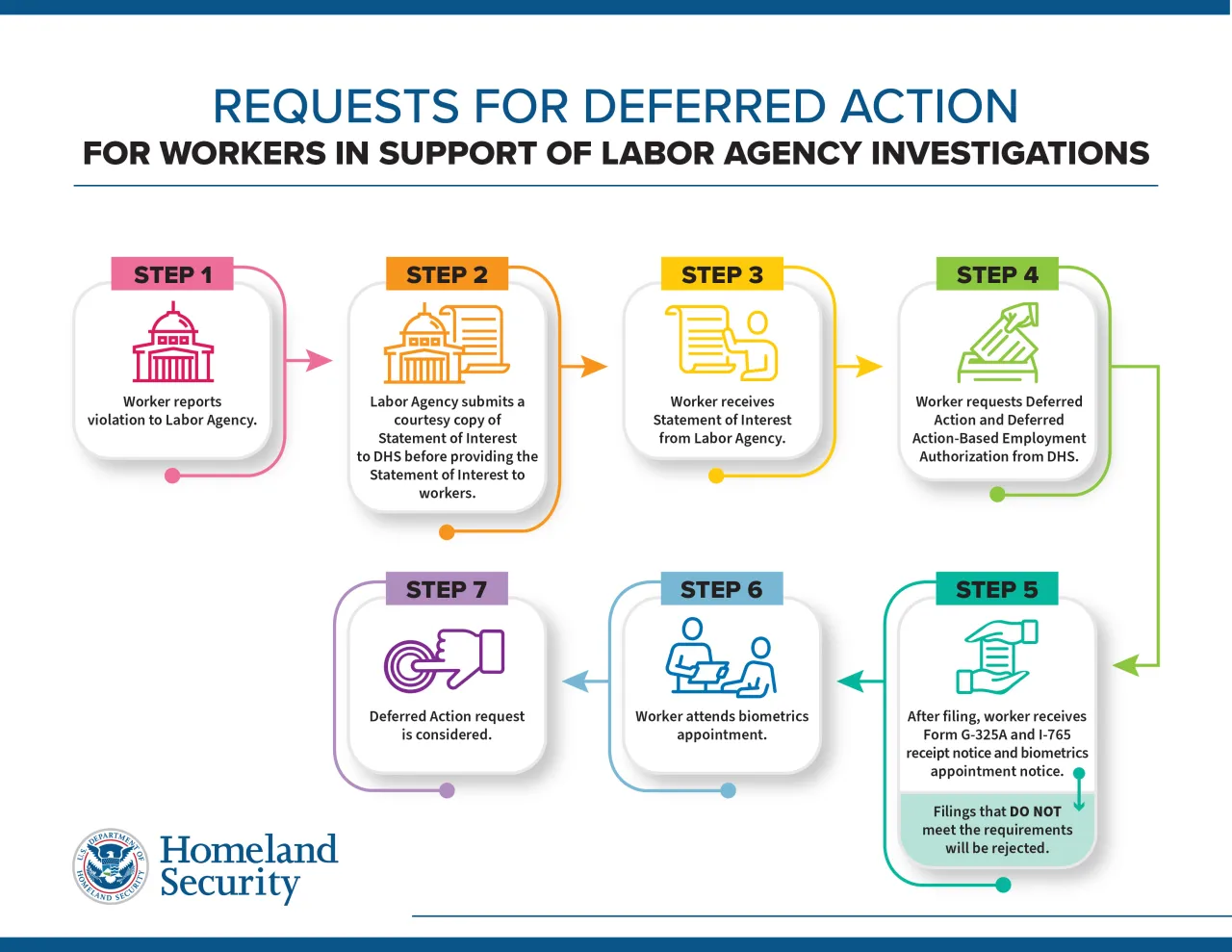
Applying for DALE involves submitting a request through a specific U.S. Citizenship and Immigration Services (USCIS) process. Workers can initiate the application by requesting a Statement of Interest (SOI) from the appropriate labor agency and then filing that SOI along with Forms G-325A and I-765 to USCIS. Applicants must attend a biometrics appointment while the application process is ongoing, and will generally receive a decision within four to six months.

Image: Requests for Deferred Action for Workers in Support of Labor Agency Investigations English Infographic

Validity of Work Permits

Once approved, DALE offers a work permit that typically lasts for four years. It previously was only issued for two years, but in July of 2024, the duration of the work permit was extended to a full four years. This permit allows workers to be legally employed in the United States during this period. In some instances, the protections can be extended, especially if the worker continues to be involved in labor enforcement efforts or if the conditions warrant further protection. If you previously applied for DALE and were only given a two-year work permit card, you may be eligible to extend your work permit for an additional two years.

Support and Accessibility

DALE does not impose criminal bars, meaning that a wide range of workers, including those with past minor offenses, can apply for this protection. This broad accessibility is crucial for encouraging more workers to report labor violations without fearing retaliation in the form of deportation. However, if you do have any prior immigration or criminal violations, it is advisable to consult with an attorney about the risks associated with any application prior to filing for these benefits.


Last Updated: 7.29.2024 (*Note That Immigration Rules, Regulations, And Practices Change Frequently. Make Sure To Check For Updated Information Since The Posting Of This Article.)
President Biden’s Action to Keep Families Together (June 2024)

On June 18 2024, President Biden announced a presidential extension of the program known as “Parole in Place”. The purpose of this parole program is to allow persons that are already in the United States but who entered illegally to seek a lawful entry without having to ever leave the United States. Most popularly used by family of U.S. military members, Biden is now extending it to the spouses of U.S. citizens and their children.

Traditionally, if the spouse of a U.S. citizen entered the United States illegally, they must seek a hardship waiver and further processing of an immigrant visa for a green card (lawful permanent residency) outside of the United States, often necessitating long periods of time outside of the United States, separated from their families. Biden’s announcement is meant to keep families unified by allowing the application for a green card (lawful permanent residency) to take place within the United States, without requiring any departure from the United States or time spent abroad.

Though additional details have still yet to be announced, the known qualifications are currently that an applicant must:

  • Be present in the United States without admission or parole;
  • Have been continuously in the United States for at least 10 years as of June 17, 2024;
  • Have a legally valid marriage to a US Citizen as of June 17, 2024;
  • Not be disqualified based on criminal history;
  • Deserving of a favorable exercise of discretion.

So long as these criteria are met, the spouse and children (unmarried and under 21yo) of a US citizen may seek a “parole in place” for a period of three (3) years to allow them to obtain a work permit and to complete the immigration process more seamlessly from within the United States.

In this same announcement, President Biden remarked that he also plans to make non-immigrant visas more accessible to persons with DACA  and other Dreamers with degrees from US institutions of higher education. For these individuals who have a job offer from a U.S. employer, this new action will seek to make it possible to obtain a non-immigrant employment visa where one otherwise may not have been possible due to various immigration bars.

These programs are not yet available so please do not pay any fees associated with filings or submit documents in application for these benefits as it is not yet available. Beware of scams and persons trying to take advantage of this announcement. Additional information is expected to be released soon in order to help individuals determine whether their case may or may not benefit from this announcement. Stay tuned!


Last Updated: 6.18.2024 (*Note That Immigration Rules, Regulations, And Practices Change Frequently. Make Sure To Check For Updated Information Since The Posting Of This Article.)

President Biden’s Action to Secure the Border (June 2024)

On June 4, 2024, President Biden announced his new Presidential Proclamation to try and curb illegal border entries at the southern border. The proclamation restricts entry to the United States for those entering without a visa or other lawful permission. The new measures went into effect today, June 5, 2024. For more detailed information, please visit: https://www.whitehouse.gov/briefing-room/presidential-actions/2024/06/04/a-proclamation-on-securing-the-border/


Last Updated: 6.5.2024 (*Note That Immigration Rules, Regulations, And Practices Change Frequently. Make Sure To Check For Updated Information Since The Posting Of This Article.)

New USCIS Fees Announced for 2024!

On January 30, 2024, USCIS announced the final rule for an adjusted fee schedule. The changes to fees impact many categories of applications and will go into effect on April 1, 2024. Anything postmarked on or after April 1, 2024 will be subject to the new fees. To apply under the current fee schedule, applications must be postmarked before April 1, 2024.

USCIS press release: https://www.uscis.gov/newsroom/news-releases/uscis-issues-final-rule-to-adjust-certain-immigration-and-naturalization-fees

To read the rule in its entirety (it’s long!), you can go here: https://www.federalregister.gov/documents/2024/01/31/2024-01427/us-citizenship-and-immigration-services-fee-schedule-and-changes-to-certain-other-immigration

To read the USCIS FAQ’s about the change (much shorter), you can go here: https://www.uscis.gov/forms/filing-fees/frequently-asked-questions-on-the-uscis-fee-rule

If you need to apply for a fee waiver, you can find out your eligibility by comparing your household income to the federal poverty guidelines, which are found here: https://aspe.hhs.gov/topics/poverty-economic-mobility/poverty-guidelines

Moving? Update Your Address With Immigration!

If you have a pending application or petition with an Immigration agency, or if you are a non-US citizen, you will need to file a change of address anytime you move (unless you are in the US with a “A” or “G” visa or as a Visa Waiver Visitor). You must file the change of address with every agency that is handling your case, whether it is U.S. Citizenship and Immigration Services, the U.S. Department of State, the Immigration Court, or another agency/office.

Here are some links and information to help you get the change of address done correctly. And, remember, make sure you file your change of address the FIRST WEEK you move! Most agencies require that they be updated within 5-10 business days of your move.

If you have a case pending with U.S. Citizenship and Immigration Services (USCIS):
– Paper filing/general instructions: https://www.uscis.gov/ar-11

– Online filing: https://egov.uscis.gov/coa/displayCOAForm.do

– Special filing locations for U/T/VAWA cases: https://www.uscis.gov/addresschange

If you are a financial sponsor for an intending immigrant and have filed Form I-864:
– Paper filing: https://www.uscis.gov/i-865

If you have a case pending with the Immigration Court / Executive Office for Immigration Review (EOIR):
– Paper filing: https://www.justice.gov/eoir/form-eoir-33-eoir-immigration-court-listing

– Online filing: https://respondentaccess.eoir.justice.gov/en/forms/eoir33ic/

*Remember, anything you send to the Immigration Court, must also be sent to the Office of Principal Legal Advisor (OPLA) with Homeland Security, by mail. For the correct address, search by location: https://www.ice.gov/contact/field-off…

If you are reporting to Immigration and Customs Enforcement (ICE):
– Online filing: https://onlinechangeofaddress.ice.gov/ocoa

If you are a bond obligor:
– Paper filing: https://www.ice.gov/doclib/forms/i333.pdf

If you have a case with the National Visa Center (NVC) or the U.S. Embassy for consular processing:
– https://travel.state.gov/content/travel/en/us-visas/visa-information-resources/ask-nvc.html

HOW TO: Humanitarian Parole For Cubans, Haitians, Venezuelans, And Nicaraguans

In 2023, the Biden Administration began a process that allowed certain nationals of Cuba, Haiti, Venezuela, or Nicaragua to enter the United States through Humanitarian Parole. In an effort to curb illegal entries to the United States, and recognizing the dire need for many persons from these countries to leave difficult situations in their home countries, the humanitarian parole process allows for temporary entry and employment authorization in the United States. If you are a citizen of Cuba, Haiti, Venezuela, or Nicaragua, here is how you may seek to benefit from this program…

For starters, you must be outside of the United States and a national of Cuba, Haiti, Venezuela, or Nicaragua, and with a valid passport. If you are not a national of one of these countries, you may still qualify if you are the spouse or unmarried child under the age of 21 of a national of one of these 4 countries. For example, if you are a citizen of Mexico but you are married to a Cuban citizen and you’re living outside of the U.S., you can apply for this parole program so long as you’ll be traveling together and your Cuban citizen spouse receives parole. BUT, if your Cuban citizen spouse also has Mexican citizenship, neither of you will be eligible for this program because of your Cuban spouse’s dual nationality.

In addition to meeting the citizenship requirement, you must have a sponsor in the United States to start the process. This sponsor doesn’t have to be a U.S. citizen, but must have lawful status in the U.S. or be with parole or deferred action. If you know someone that is a U.S. citizen, a Lawful Permanent Resident, a nonimmigrant (such as with F1 student status), an Asylee or Refugee, a TPS holder, or a
DACA recipient, they may serve as your sponsor.

The sponsor must be able to document their status, be able to pass a background clearance, and have sufficient financial means to support you. Once you find someone that is willing to serve this role, they will initiate the process by creating an online U.S. Citizenship and Immigration Services (USCIS) account and filing Form I-134A. If you have a spouse or child that will be traveling with you, a separate I-134A must be filed for each person. With the I-134A form, it is necessary to include evidence about the financial ability to support you, including an explanation of the type of support to be provided. Because the sponsor is agreeing to “receive, maintain, and support” the beneficiary, the sponsor must specifically account for how this is possible. But the sponsor doesn’t have to take all the responsibility for him or herself. Meaning that multiple people can agree to help, and even organizations and businesses can agree to help. For example, if your friend, Mariam, lives in the United States with Temporary Protected Status (TPS), she can be your sponsor. But maybe she only makes $20,000 a year and doesn’t think she can pay for your housing, food, and transportation. But, Mariam knows a local community organization that is offering to help provide housing and food. And Mariam also has a friend that is offering to help you find a job and provide $250 in support per month, until you get to the U.S. and get a work permit and job. In this situation, Mariam will file and sign the I-134A form, but she will include with it an explanation from herself, the local community organization, and her friend, each explaining how they will provide for you once you arrive to the United States. Along with these letters of explanation, it is a good idea to provide other documentation that evidences the ability to provide the resources that were offered, such as photos of the available housing or a deed of title from the community organization, and tax returns or bank statements from Mariam’s friend.

Once the I-134A is filed and submitted online, USCIS will review it, check for the criminal clearance of the sponsor, and make a determination about whether to authorize the sponsorship. This part of the process may take several months or more. Then, assuming the sponsor is confirmed, you will receive an email from USCIS with instructions about how to create your own online USCIS account. You’ll create this account and confirm the information about yourself and your qualifications. In doing so, you will confirm that you have all required vaccinations to enter the U.S., including vaccinations for Measles,Polio, and COVID-19.

After you confirm the information with USCIS, you will receive instructions in your new online account about how to access the CBP One app on your phone. You will enter your personal information into the application and provide a photo of yourself. Once all information is entered into the CBP One app, you will wait to receive notice about whether Customs and Border Protection (CBP) has decided to authorize you to travel the United States to request parole at a port of entry. Assuming CBP has decided to grant you this opportunity, you’ll receive travel authorization that is valid for 90 days. You must enter the United States during those 90 days, traveling by air to an internal port of entry. It is at that port of entry that you will request parole.

Once you arrive by plane to a receiving airport in the United States, you will meet with a CBP officer who will run your fingerprints for a background check and you will provide an explanation and documentation for the reasons why you are seeking parole into the U.S. It is advisable to have your explanation and documentation well-prepared and easy to understand so that you can simply and quickly present it to the officer when you are at the airport. For example, maybe the circumstances in your home country caused you to lose your job or your housing, maybe it is no longer safe there for your children to attend school, or maybe you are no longer able to freely express your political or religious beliefs in your home country. Be prepared to clearly express your personal reasons for leaving your home country and seeking temporary entry into the U.S.

If the officer agrees to parole you into the United States, you will typically be allowed entry for a two (2) year period and you will be eligible to apply for a work permit. It is a good idea to apply for that work permit as soon as possible, by filing Form I-765. Remember also that you are required to update your contact information (phone number, email, and physical address) with USCIS if it changes after you enter the United States. You can do this through your online USCIS account that you created during the application process.

Who Is Not Eligible For This Process?
  • If you fail the security clearance
  • If you are unable to demonstrate that the U.S. government should exercise its discretion in your
    favor
  • If you have been ordered removed from the U.S. in the last 5 years
  • If you are subject to a bar based on a prior removal order
  • If you entered the U.S. illegally and not at a port of entry after October 19, 2022 for Venezuelans
    and after January 9, 2023 for Cubans, Haitians, and Nicaraguans
  • If you are Cuban or Haitian and were intercepted at sea trying to come to the U.S. after April 27,
    2023; or
  • If you are under 18 years of age and not traveling with a parent or legal guardian
Sources:
Last Updated: 10.15.2023 (*Note That Immigration Rules, Regulations, And Practices Change Frequently. Make Sure To Check For Updated Information Since The Posting Of This Article.)

Spark Up Your Love Story With The Fiancee Visa!

Are you a smitten U.S. Citizen eager to bring your beloved to the land of stars and stripes for good? Look no further than the enchanting Fiancee Visa, also known as the K-1 Visa! If you’ve ever been hooked on the show “90 Day Fiancee,” you’ll soon recognize where that show gets its catchy name.

As a U.S. Citizen, you can apply for your fiance(e) to come to the United States on a K-1 “Fiancee Visa” so long as you have the intention to marry within the first 90 days of arrival to the United States. To apply for this benefit, you (the U.S. Citizen), must submit Form I-129F to U.S. Citizenship and Immigration Services (USCIS). You must prove that (1) you are a U.S. Citizen, (2) that you are free and able to marry (that you aren’t married to anyone else and that you meet the necessary requirements for marriage in your jurisdiction), (3) that you intend to marry within those first 90 days after K-1 entry, and (4) that you and your fiance(e) met one another in person at least once during the two years preceding the filing of the petition (some exceptions to this do exist).

Once your I-129F petition gets the thumbs up, it’s off to the races! The approval will be forwarded to the U.S. Department of State’s National Visa Center (NVC). The NVC will then determine the appropriate Embassy or Consulate, depending on your fiancee’s nationality and residence, and will forward it on to that location for purposes of contacting the applicant to submit the required application forms and schedule the K-1 interview. The applicant (your fiance(e)) will file Form DS-160 online for themselves and for any accompanying children. They’ll also need to attend a medical exam with an approved physician.

Then, once the interview is scheduled, all applicants will attend the interview, taking with them all required documentation. Required documents include a passport valid for at least 6 months from the date of intended entry into the U.S., Form I-134 and supporting financial documents, a police certificate, any divorce decrees, birth certificates, 2×2 photographs, and evidence of your relationship.

Note that by the time you reach the interview stage for the case, the I-129F approval period of 4 months will have already likely expired. Do not stress over this because the consular officer at the interview can extend the validity dates of the petition. Once the K-1 visa is approved (K-2 for any children), it will be valid for a maximum of 6 months. It is necessary to enter the United States before that visa expires. And, remember, in order to remain in the United States, the marriage should take place within 90 days of entry.

After marriage, to remain lawfully in the United States, it is necessary to then apply to adjust status to a Lawful Permanent Resident (Form I-485). If there are any children that entered the United States on a K-2 visa, they must also apply to adjust status to a Lawful Permanent Resident. Remember that for the children to do this, they must be unmarried and must enter the United States before turning 21 years of age.

Pros To The Fiancee Visa:
  • No need to rush down the aisle before applying – in fact, if you’re already hitched, this visa isn’t for you!
  • It can fast-track the family reunion process in the U.S.
Cons To Consider:
  • The wedding bells must ring quickly after stepping onto U.S. soil on the K-1 Visa.
  • There’s still a (sometimes marathon-length) green card application process after the vows.
  • If the relationship takes an unexpected turn, adjusting your status becomes a bit trickier.
  • While a work permit is on the table, it’s only valid for 90 days post-entry, and processing times might not leave much time for job hunting.

So there you have it, lovebirds! With the Fiancee Visa, your love story is set for an epic U.S. adventure. Time to get those applications in and let the countdown to happily ever after begin!

Sources:
Last Updated: 10.07.2023 (*Note That Immigration Rules, Regulations, And Practices Change Frequently. Make Sure To Check For Updated Information Since The Posting Of This Article.)

The Visa Lottery

Feeling lucky? Then you may want to take a turn at winning permanent residency in the United States through the Diversity Visa Lottery!

Each year, between 50,000 – 55,000 immigrant visas are available to natives of underrepresented countries. If you were born in a country that has sent fewer than 50,000 immigrants to the United States over the last 5 years, then you may be able to enter the lottery. The lottery opens up at the start of the new fiscal year each year (October 1) and the countries that are eligible will be listed.

If you were born in one of the listed countries (or fall into an exception that allows you to utilize the birthplace of your spouse or parent), you will qualify to enter the lottery so long as you meet the necessary education or experience requirements. To satisfy the education/experience requirement, you must either have a high school diploma, or, you must have at least 2 years of experience during the last 5 years in a job or trade that normally requires at least 2 years of experience. Not sure if you have the necessary experience? You can search it on the O*Net online library. See also the Department of State’s website for additional information on proving your qualifications.

If you were born in a country that does NOT qualify for the visa lottery, you may still be eligible if your spouse was born in an eligible country, or, if neither of your parents were born in your country of birth and they were also not residents of that country at the time of your birth. In those situations, you may claim the country of either your spouse or your parent(s) for purposes of eligibility.

If you’re selected in the lottery, your spouse and children (unmarried and under 21 years old) may also apply for immigrant visas along with you. Even if your spouse or children do not plan to come to the United States, make sure you list all of them in your application. If you want to increase your odds of winning, you can each submit an individual application. The Department of States clarifies in its FAQ that spouses may each submit a separate entry, ultimately utilizing the entry of the winning spouse. But make sure that you only submit one entry for yourself. If you submit more than one for yourself, you will be disqualified.

Most applicants for this process are out of the country, but you can also apply if you’re in the United States. Remember that normal grounds of inadmissibility do apply so if you’re in the United States but in violation of immigration laws, then you may not be admissible to the United States. The waivers that normally apply to immigrant visas are available for this process, as well. One potential problem in relying upon a waiver is the timing. Waivers can take a really long time to get, and this diversity visa process is quick and fast with a hard out deadline.

The 50,000 visas that are authorized for each fiscal year must be used during that fiscal year. So, for example, if you’re selected for the 2025 fiscal year visa lottery, you must complete the process and receive your immigrant visa between October 1, 2024 and September 30, 2025. No exceptions.

Generally speaking, the new lottery opens up each year in the first week of October. The lottery that opens up will be for the following fiscal year, not for the fiscal year that just started. Meaning that, if you apply for the diversity visa lottery on October 5, 2023 (which is the first week of the 2024 fiscal year), you are applying for the 2025 fiscal year lottery. Let’s look at the timing for the 2024 fiscal year to break down an approximate timeframe for how things might look if you are interested in applying for the visa lottery:

  • October 5, 2022 – November 8, 2022: Registration period opened for 2024 fiscal year. If you want to enter the lottery, you must register online during this time period.
  • May 6, 2023 (until at least September 30, 2024): Persons selected in the lottery begin to be announced. To find out if your entry was selected, you will search it online, and you MUST know your confirmation number, name, and year of birth. If you are selected, you must follow the instructions provided for how to proceed, which includes filing a DS-260 application (or, if you’re in the United States, an I-485 application).
  • October 1, 2023: Visas may be issued for 2024 fiscal year lottery winners. Once the new fiscal year begins, visas can begin to be issued until such time as all available visas are used, or the end of the fiscal year is reached, whichever comes first.
  • September 30, 2024: Last day for visas to be issued for the 2024 fiscal year lottery winners.

Most lotteries cost money to enter. But, this one, is FREE! Unless, of course, you count the time it takes to get the application and documents together and the fees it will later cost if you’re actually selected during the lottery and move forward in the process.

To give you an idea of just how popular this lottery is, there were 22,185,619 qualified entries for the 2024 fiscal year. With a maximum of 55,000 available visas, this means there is less than 0.25% chance of being selected. But, somebody has to win! And if you want to come live in the United States and don’t have another way to do it, this sure seems worth a shot!

Sources:
Last Updated: 9.10.2023 (*Note That Immigration Rules, Regulations, And Practices Change Frequently. Make Sure To Check For Updated Information Since The Posting Of This Article.)

Family Reunification Parole

Family Reunification Parole – or FRP – is a process to benefit nationals of Cuba, Haiti, Guatemala, Colombia, El Salvador, and Honduras, who have a pending I-130 petition for alien relative. The process allows certain beneficiaries of an I-130 petition to come to the United States pursuant to a grant of parole, as opposed to having to wait out of the United States for the often lengthy wait times. Once the individual enters the United States pursuant to the parole document, s/he is eligible to apply for employment authorization. The parole will generally be granted for a period of up to 3 years and may be eligible for renewal.

Once an I-130 application filed by a Lawful Permanent Resident (LPR) or U.S. Citizen (USC) is approved, the Department of State’s National Visa Center (NVC) will decide to whom it will issue a letter of invitation to apply for the parole process. It will make this decision on a case-by-case basis, taking into consideration its capacity and the length of wait time left remaining before it will be possible to immigrate to the United States pursuant to the I-130 petition. Presumably, the longer the wait out of the country, the more likely it will be that an invitation for parole will be extended.

To be eligible for this parole, the petitioner of the I-130 application must reside in the United States and the beneficiaries must reside out of the United States. The principal beneficiary must be a national of either Cuba, Haiti, Guatemala, Colombia, El Salvador, or Honduras, but does not have to reside in one of those countries so long as s/he resides outside of the United States. The nationality of the derivative beneficiaries is not pertinent to their eligibility so long as the principal beneficiary can establish nationality from one of the qualifying countries. Each person intending to enter the United States pursuant to parole must have a valid, unexpired passport.

To apply for this parole, the petitioner must first receive an invitation letter that will be sent by the NVC. Make sure that the email address and mailing address that is on file with the NVC is up-to-date (use this webpage to update your information). You will have 12 months from the date of the invitation letter during which to submit Form I-134A. The invitation letter will identify the I-130 beneficiary and any derivative family members that are eligible to apply for the parole process. Once the petitioner receives the letter, the petitioner must initiate the process to bring his/her family members into the United States by filing online Form I-134A. Keep in mind that there are no age limits for principal beneficiaries, but any derivative beneficiary children must be under the age of 21 at the time the I-134A is received.

The I-134A application must be completed online; paper filings are not accepted. A separate application must be filed for each family member that intends to come to the United States, but it can all be done under one single USCIS account, listing additional family members as travel group members. No fee is required. If a new derivative beneficiary has been added since the time of the I-130 application (such as through the birth of a new child) and their name is not listed in the invitation letter, you may still file an I-134A on their behalf if you submit the necessary proof of relationship and eligibility. The I-130 petitioner must initiate the I-134A process and submit proof of financial ability to support those intending to enter the United States. If additional income or assets are necessary to prove financial ability to support, it is permissible to have additional sponsors who can combine their income and assets for financial support.

Processing times for the I-134A will vary and inquiries about a case are not currently accepted unless it has been processing for more than six (6) months. Once the I-134A is accepted and processed, USCIS will send an email to the beneficiaries with instructions about how to create an online myUSCIS account to submit biographical information and attestations. It will be necessary to undergo a medical examination and certify that all necessary vaccinations have been received. In reviewing the background of applicants, persons from Colombia, Guatemala, El Salvador, or Honduras will be disqualified if it is determined that they have an illegal entry to the US after July 10, 2023, or were interdicted at sea by the U.S. Coast Guard after July 10, 2023, or were ordered removed within the previous 5 years, or are inadmissible due to a prior removal order. These same disqualifications do not apply to Haitian or Cuban applicants, and instead will only be considered in a discretionary determination.

Once all information is completed online, the myUSCIS account will be updated with information about how to download the CBP One mobile application. Using the mobile app, the beneficiary applicant must upload more biographical data and a photo. Once complete and reviewed, Customs and Border Protection (CBP) will provide online notice to the applicant about its decision of whether or not to issue authorization to travel to the United States. Once authorization to travel is issued, the applicant will generally have a 90-day window in which to enter the United States pursuant to the grant of parole. A one-time extension of the 90-day parole period may be granted, at the discretion of CBP, but it must be submitted no more than 30 days before, and no more than 30 days after, the expiration date of the original parole period.

In order to enter the United States with the advance travel authorization, it is necessary to fly in a commercial plane to the United States and be inspected by CBP at an internal port of entry. Travelers will not be processed for this method of parole at land ports of entry but will instead be denied entry. Once you arrive to the internal port of entry, you will undergo additional screening with CBP (including fingerprint biometrics) who will make the final decision to parole you into the United States. Derivative beneficiaries will only be allowed parole into the United States once the principal beneficiary has been paroled into the United States.

Once you have been paroled into the United States, you are eligible to apply for employment authorization under category (c)(11). If you want to temporarily leave the United States, you must first obtain an Advance Parole Document by applying with Form I-131. Remember that once you enter the United States and remain for longer than 30 days, you must update your address (https://www.youtube.com/watch?v=MoObatBGRLk) with USCIS anytime you move.

If your visa number becomes current while you are lawfully in the United States pursuant to an authorized parole entry, you may be eligible to adjust your status to a Lawful Permanent Resident. Remember that any violations of your parole or an overstay of any authorized period of parole may have negative consequences for your immigration case.

Cuban And Haitian Parole

Prior to August 11, 2023, Cuban and Haitian nationals could benefit from a parole process different from that explained above, which instead utilized Form I-131 and required an in-person interview. However, as of August 11, 2023, Cuban and Haitian nationals will now use the process set forth above to apply for parole, which involves filing Form I-134A and does not require an in-person interview. If a Cuban or Haitian national already initiated the process using Form I-131, the NVC will send the applicant a letter to explain how the case will proceed.

Most parolees will not be eligible to adjust status to a lawful permanent resident, unless and until their immigrant visa number is current. However, Cuban parolees may be eligible to adjust under the Cuban Adjustment Act a year after entry.

Sources:
Last Updated: 9.10.2023 (*Note That Immigration Rules, Regulations, And Practices Change Frequently. Make Sure To Check For Updated Information Since The Posting Of This Article.)

What Information Is In My Immigration File?

Have you ever wondered what exists in your file with immigration? What information or documentation they may have about you that even you don’t know or remember? There’s an easy solution to that. Request a copy of the file!

Through the Freedom of Information Act (FOIA), you can submit a request for information and documentation to any federal agency. When you want information about your own file, you’ll have to provide sworn proof of your identity for the agency to release the information. You can do this by completing the federal FOIA form of the relevant agency, which can be done by paper or by online filing.

In your request, you must specify the specific documents sought. The more specific you are in your description of documents sought, the more likely you are to receive it. However, if you just generally want your entire file copy for U.S Citizenship and Immigration Services (USCIS) then you can state on your request that you want your entire A-file copy. If you submit your request to an agency that does not have the information sought, you may be told that your request is being forwarded to another agency, or you may simply need to file a new FOIA request with a different agency.

Each agency has its own specific guidelines that you must follow. Here we provide basic instructions about how and where to file your FOIA request, based on the information sought. If you are not using a designated print or online form to make the request, it is recommended that you send a notarized letter with your name, address, date of birth, and a detailed description of the documents and information you are requesting.

  • If  you want copies of petitions or applications that were filed by you or on your behalf, you will likely need to file a FOIA request with USCIS. You can do this by filling out Form G-639 and mailing it to: National Records Center, FOIA/PA Office, P.O. Box 648010, Lee’s Summit, MO 64064-8010. OR, you can create an online USCIS account and fill out the request online.
  • If you want copies of your passport, visas, or applications filed for visas to enter the U.S., you will likely need to file a FOIA request with the U.S. Department of State (DOS). You can do this by mailing in the request to Office of Information Programs and Services (IPS), U.S. Department of State, State Annex 2 (SA–2), 515 22nd Street, NW., Washington, DC 20522–8100. OR, you can create an online account and fill out the request online.
  • If you want records of your entries and exits to and from the United States, any interview notes from border detentions, records of a voluntary return, or an I-94 admission record, you will likely need to file a FOIA request with U.S. Customs and Border Protection (CBP).  You can do this by mailing in the request to 90 K Street NE MS 1181, Washington, DC 20229. OR, you can create an online account and fill out the request online. Note that this is the same online account that is used for ICE and OBIM FOIA requests.
  • If you want records of your detention in the country (not at the border or port of entry), records of a Notice to Appear, or records of bond paperwork, you will likely need to file a FOIA request with Immigration and Customs Enforcement (ICE). You can do this by mailing in the request to U.S. Immigration and Customs Enforcement, 500 12th Street SW, Stop 5009, Washington, DC 20536-5009. OR, you can create an online account and fill out the request online. Note that this is the same online account that is used for CBP and OBIM FOIA requests.
  • If you want to find records that relate to arrests, investigations, or border interactions during which your biometrics or fingerprints were taken, you will likely need to file a FOIA request with the Office of Biometric Identity Management (OBIM). You can do this by mailing in the request to Privacy Office, Mail Stop 0655, Department of Homeland Security, 2707 Martin Luther King Jr. AVE SE, Washington, DC 20528-065. Your request must be sent with an Affirmation Declaration and a properly completed fingerprint card. OR, you can create an online account and fill out the request online. Note that this is the same online account that is used for CBP and ICE FOIA requests.
  • If you want to find copies of filings made with the Immigration Court during removal proceedings or orders from an immigration judge, you will likely need to file a FOIA request with the Executive Office for Immigration Removal (EOIR). You can do this by mailing in the request to: Office of the General Counsel Attn: FOIA Service Center, Executive Office for Immigration Review, 5107 Leesburg Pike, Suite 2150, Falls Church, VA 22041. All requests must be filed with a signed verification of identity (or use Form DOJ-361). OR, you can create an online account and fill out the request online.

When you receive your FOIA response, you may notice that some pages or pieces of information are redacted or excluded. This information may be withheld by the federal agency if it is deemed to be any of the following:

1. Information that is classified to protect national security.
2. Information related solely to the internal personnel rules and practices of an agency.
3. Information that is prohibited from disclosure by another federal law.
4. Trade secrets or commercial or financial information that is confidential or privileged.
5. Privileged communications within or between agencies.
6. Information that, if disclosed, would invade another individual’s personal privacy.
7. Information compiled for law enforcement purposes that:
a. Could reasonably be expected to interfere with enforcement proceedings
b. Would deprive a person of a right to a fair trial or an impartial adjudication.
c. Could reasonably be expected to constitute an unwarranted invasion of personal privacy.
d. Could reasonably be expected to disclose the identity of a confidential source.
e. Would disclose techniques and procedures for law enforcement investigations or prosecutions, or would disclose guidelines for law enforcement investigations or prosecutions if such disclosure could reasonably be expected to risk circumvention of the law.
f. Could reasonably be expected to endanger the life or physical safety of any individual.
8. Information that concerns the supervision of financial institutions.
9. Geological information on wells.

When information is withheld, you can either accept it as is, or you can challenge the agency by filing an administrative appeal. To file an appeal, write a letter explaining your reason for the appeal, mark the letter and envelope clearly with “Freedom of Information Act Appeal”, and mail it to: USCIS FOIA/PA Appeals Office, 150 Space Center Loop, Suite 500, Lee’s Summit, MO 64064-2139.

When information is withheld, you can either accept it as is, or you can challenge the agency by filing an administrative appeal. To file an appeal, write a letter explaining your reason for the appeal, mark the letter and envelope clearly with “Freedom of Information Act Appeal”, and mail it to: USCIS FOIA/PA Appeals Office, 150 Space Center Loop, Suite 500, Lee’s Summit, MO 64064-2139.

Sources:
https://www.foia.gov/faq.html#:~:text=Exemption%201%3A%20Information%20that%20is,disclosure%20by%20another%20federal%20law
https://www.uscis.gov/records/request-records-through-the-freedom-of-information-act-or-privacy-act
https://www.ecfr.gov/current/title-22/chapter-I/subchapter-R/part-171