SEPTEMBER 2025 NEWSLETTER

Tougher Road to U.S. Citizenship

(Arduo camino hacia la ciudadanía estadounidense)

EN: USCIS has announced new policies that make the path to citizenship more difficult. Officers may now conduct “neighborhood checks,” reaching out to neighbors or coworkers to ask about an applicant’s character. Applicants are also being asked for more proof of integration, such as steady work, financial stability, and community involvement. In addition, stricter rules for good moral character have been restored, meaning past immigration or legal issues may weigh more heavily against applicants.

ES: USCIS ha anunciado nuevas políticas que dificultan el camino hacia la ciudadanía. Los oficiales ahora pueden realizar “revisas comunitarias”, contactando a vecinos o compañeros de trabajo para preguntar sobre el carácter de un solicitante. A los solicitantes también se les exige más pruebas de integración, como empleo estable, estabilidad financiera e involucramiento comunitario. Además, se han restablecido reglas más estrictas sobre el buen carácter moral, lo que significa que problemas migratorios o legales anteriores pueden pesar más en contra de los solicitantes.


USCIS Authority Expands to Include Enforcement

(USCIS amplía su autoridad para incluir acciones de control migratorio)

EN:

In May 2025, Secretary of Homeland Security Kristi Noem issued a directive granting USCIS the authority to carry out expedited removal. This change only came to light in August 2025 through ongoing litigation. Traditionally, USCIS has been the agency responsible for providing immigration benefits to applicants and their families. Under this new directive, however, USCIS may now take on an enforcement role by determining during the review of an application whether an individual is subject to expedited removal. Learn more about expedited removal here.

In addition, USCIS may issue Notices to Appear if it determines that an applicant or beneficiary is not eligible for the immigration benefit they are seeking. In such cases, the individual may be placed directly into removal proceedings.

ES:

En mayo de 2025, la Secretaria de Seguridad Nacional Kristi Noem emitió una directiva que otorga al USCIS la autoridad para llevar a cabo remociones aceleradas. Este cambio solo salió a la luz en agosto de 2025 a través de litigios en curso. Tradicionalmente, USCIS ha sido la agencia responsable de proporcionar beneficios migratorios a solicitantes y sus familias. Sin embargo, bajo esta nueva directiva, el USCIS ahora puede asumir un papel de autoridad de la ley al determinar durante la revisión de una solicitud si un individuo está sujeto a remoción acelerada. Conoce más sobre la remoción acelerada aquí.

Además, el USCIS puede emitir Avisos para Comparecer si determina que un solicitante o beneficiario no es elegible para el beneficio migratorio que está solicitando. En tales casos, la persona puede ser incluida directamente en procedimientos de deportación.


Restrictions on Non-Immigrant Visas

(Restricciones para visas de no-inmigrantes)

EN: In an ongoing effort by the Trump administration to limit nonimmigrant visas, USCIS has launched a pilot program requiring certain tourist visa applicants from Malawi and Zambia to post a financial bond of between $5,000 and $15,000 before entering the United States. The bond would be refunded only after the traveler departs within the permitted timeframe of their visa. While currently limited to these two countries, the program could be expanded to others depending on how it is implemented.

The administration has also proposed a new regulation that would place fixed terms of stay on specific nonimmigrant visa categories, including international students (F visas), exchange visitors (J visas), and foreign journalists (I visas). This would mean that even if a study program, exchange placement, or assignment lasts longer, the visa would expire at the fixed term—requiring renewal and adding new uncertainty for those relying on these visas.

ES: En un esfuerzo continuo de la administración Trump por limitar las visas de no inmigrantes, USCIS ha lanzado un programa piloto que requiere que ciertos solicitantes de visas turísticas de Malawi y Zambia paguen una fianza de entre $5,000 y $15,000 antes de ingresar a los Estados Unidos. La fianza solo se reembolsará después de que el viajero salga dentro del plazo permitido de su visa. Si bien actualmente se limita a estos dos países, el programa podría ampliarse a otros según su implementación.

La administración también ha propuesto una nueva regulación que establecería plazos fijos de estadía para categorías específicas de visas no inmigrantes, incluyendo estudiantes internacionales (visas F), visitantes en intercambio (visas J) y periodistas extranjeros (visas I). Esto significaría que incluso si un programa de estudios, un intercambio o una asignación dura más tiempo, la visa expiraría en el plazo fijado, requiriendo renovación y añadiendo nueva incertidumbre para quienes dependen de estas visas.


More News to Know…

(Otras noticias que deberías saber)

EN:

  • As Trump continues to fire experienced immigration judges, he seeks to bring in new temporary judges with little or no experience.
  • A federal judge has ordered the eviction of all remaining detainees from Florida’s controversial “Alligator Alcatraz” immigration facility, with state officials confirming that the site is expected to be completely vacated within days, though the decision is already being appealed.
  • The August 19, 2025 USCIS policy update adds new discretionary factors, including considerations of “anti-American activity”, but critics caution that such broad discretion could lead to bias and inconsistency.

ES:

  • Mientras Trump continúa despidiendo jueces de inmigración experimentados, busca traer nuevos jueces temporales con poca o ninguna experiencia.
  • Un juez federal ha ordenado el desalojo de todos los detenidos restantes de la controvertida instalación migratoria “Alligator Alcatraz” de Florida, con funcionarios estatales confirmando que se espera que el lugar quede completamente vacío en cuestión de días, aunque la decisión ya está siendo apelada.
  • La actualización de políticas del USCIS del 19 de agosto de 2025 añade nuevos factores discrecionales, incluyendo consideraciones de “actividad antiestadounidense”, pero los críticos advierten que tal amplia discreción podría llevar a sesgos e inconsistencias.

AUGUST 2025 NEWSLETTER

New Immigration Fees and Enforcement Under the “Big Beautiful Bill”

(Nuevas tarifas migratorias y fuerzas del orden bajo la ley “Big Beautiful Bill”)


EN: Trump’s “Big Beautiful Bill” passed through Congress and was signed into law on July 4th, adding new immigration filing fees and promising an increase in enforcement. Under the new law, many humanitarian applications that were previously free – such as asylum and Temporary Protected Status (TPS) – now come with filing fees. Other fees, particularly those for applications filed in removal proceedings, have increased substantially. The bill also imposes new fines for immigration violations and allocates a whopping $170 billion over the next four years to expand immigration enforcement, making it the highest funded law enforcement agency in the federal government.

ES: La ley “Big Beautiful Bill” de Trump fue aprobada por el Congreso y firmada como ley el 4 de julio, agregando nuevas tarifas de trámites migratorios y prometiendo un aumento en la aplicación de la ley. Bajo la nueva ley, muchas solicitudes humanitarias que antes eran gratuitas – como asilo y Estatus de Protección Temporal (TPS) – ahora requieren pagar tarifas. Otras tarifas, particularmente para solicitudes presentadas en procedimientos de remoción o deportación, han aumentado considerablemente. La ley también impone nuevas multas por violaciones migratorias y asigna la asombrosa cifra de $170 mil millones durante los próximos cuatro años para expandir las fuerzas del orden migratorias, convirtiéndola en la agencia de las fuerzas del orden mejor financiada del gobierno federal.


Trump’s Birthright Citizenship Executive Order Stopped Again

(La orden ejecutiva de Trump sobre ciudadanía por nacimiento bloqueada nuevamente)


EN: On June 4, 2025, President Trump issued a proclamation restricting entry to the U.S. for nationals of 19 countries. Citizens of 12 countries (Afghanistan, Burma, Chad, Republic of the Congo, Equatorial Guinea, Eritrea, Haiti, Iran, Libya, Somalia, Sudan, and Yemen) face a full suspension of both immigrant and nonimmigrant visas, while nationals of 7 others (Burundi, Cuba, Laos, Sierra Leone, Togo, Turkmenistan, and Venezuela) are subject to partial restrictions. The administration cited national security threats, inadequate screening by foreign governments, and high visa overstay rates as justification. Exceptions exist for lawful permanent residents, current visa holders, and certain family or humanitarian categories, but the ban is expected to affect hundreds of thousands of people and has already sparked legal and diplomatic pushback. The policy went into effect June 9, 2025.

ES: El 4 de junio de 2025, el presidente Trump emitió una proclamación que restringía la entrada a los Estados Unidos a 19 países. Los ciudadanos de 12 países (Afganistán, Birmania, Chad, República del Congo, Guinea Ecuatorial, Eritrea, Haití, Irán, Libia, Somalia, Sudán y Yemen) enfrentan una suspensión total de las visas de inmigrante y no inmigrante, mientras que los ciudadanos de otros 7 (Burundi, Cuba, Laos, Sierra Leona, Togo, Turkmenistán y Venezuela) están sujetos a restricciones parciales. La administración citó como justificación amenazas a la seguridad nacional, la evaluación inadecuada por parte de gobiernos extranjeros y las altas tasas de sobreestadía de visas. Hay excepciones para los residentes permanentes legales, titulares actuales de visas y ciertas categorías familiares o humanitarias, pero se espera que la prohibición afecte a cientos de miles de personas y ya ha provocado un rechazo legal y diplomático. La política entró en vigencia el 9 de junio de 2025.


ICE Implements New Policy on Bond Eligibility

(ICE implementa nueva política sobre elegibilidad para fianza)


EN: Immigration and Customs Enforcement (ICE) has implemented a new policy stating that noncitizens who last entered the U.S. without being formally admitted are no longer eligible for bond set by an immigration judge and can only be released at ICE’s discretion. Under the new policy, this interpretation of the law applies no matter how long a person has lived in the U.S., their criminal record, their family or community ties, or even their eligibility for legal relief to remain in the country. Because removal proceedings often take years—especially with rising detention numbers and fewer immigration judges—it’s clear that the goal of this new policy is to deter people from pursuing legal status by forcing them to endure prolonged stays in overcrowded, poorly maintained detention centers. Advocates are fighting against this new policy, arguing that it is a misinterpretation of the law and that judges should issue bond over the objection of ICE.

ES: El Servicio de Inmigración y Control de Aduanas (ICE) ha implementado una nueva política que establece que las personas migrantes que ingresaron por última vez a EE.UU. sin ser admitidas formalmente ya no son elegibles para que un juez de inmigración les fije fianza, y solo pueden ser liberadas a discreción del ICE. Bajo esta nueva política, esta interpretación de la ley aplica, sin importar cuánto tiempo haya vivido una persona en EE. UU., su historial criminal, sus vínculos familiares o comunitarios, o incluso su elegibilidad para algún alivio legal para permanecer en el país. Debido a que los procedimientos de expulsión suelen tardar años—especialmente con números crecientes de detención y menos jueces de inmigración—queda claro que el objetivo de esta nueva política es disuadir a las personas de buscar estatus legal obligándolas a soportar estancias prolongadas en centros de detención superpoblados y mal mantenidos. Los defensores luchan contra esta nueva política, argumentando que es una mala interpretación de la ley y que los jueces deberían fijar fianza incluso si el ICE se opone.


More News to Know…

(Otras noticias que deberías saber…)

EN:

  • USCIS has quietly ended the DALE (Deferred Action for Labor Enforcement) program, which had provided temporary protection for undocumented workers who reported labor violations.
  • A bipartisan group in Congress has reintroduced the Dignity Act, a comprehensive immigration reform bill aimed at providing a path to legal status for undocumented immigrants while strengthening border security and modernizing the immigration system.
  • Some Lawful Permanent Residents have reported issues when returning to the U.S. from foreign travel. Make sure to know your rights before you go (Download Here).

ES:

  • USCIS ha eliminado discretamente el programa DALE (Acción Diferida para la Aplicación Laboral), que brindaba protección temporal a trabajadores indocumentados que denunciaban violaciones laborales.
  • Un grupo bipartidista en el Congreso ha reintroducido la Ley de Dignidad, un proyecto de ley integral de reforma migratoria que busca brindar un camino al estatus legal para inmigrantes indocumentados, mientras fortalece la seguridad fronteriza y moderniza el sistema migratorio.
  • Algunos Residentes Permanentes Legales (LPR) han reportado problemas al regresar a EE.UU. después de viajes al extranjero. Asegúrese de conocer sus derechos antes de viajar (Descargar aquí).

JULY 2025 NEWSLETTER

Supreme Court Rules on Birthright Citizenship Challenge

(La Corte Suprema emite un fallo sobre la ciudadanía por nacimiento)


EN: Soon after taking office, President Trump issued an executive order ending birthright citizenship for children born in the U.S. unless at least one parent is a U.S. citizen or lawful permanent resident. A lower court blocked the order with a nationwide injunction, but the Supreme Court overturned that injunction on June 27th—without ruling on the order’s constitutionality. The Court gave 30 days before the order can take effect and left the door open for further legal challenges. New lawsuits have already been filed seeking to block the policy through a class action. It is also anticipated that this ruling will now have a sweeping effect on other pending lawsuits challenging immigration actions, allowing new orders to take effect in some parts of the country but not others.

ES: Poco después de asumir el cargo, el presidente Trump emitió una orden ejecutiva que puso fin a la ciudadanía por nacimiento para los niños nacidos en los Estados Unidos. A menos que uno de los padres sea ciudadano estadounidense o residente permanente legal. Un tribunal inferior bloqueó la orden con una orden judicial a nivel nacional, pero la Corte Suprema la anuló el 27 de junio, sin pronunciarse sobre la constitucionalidad de la orden. El Tribunal dio 30 días antes de que la orden entrase en vigor y dejó la puerta abierta para nuevas impugnaciones legales. Ya se han presentado nuevas demandas que buscan bloquear esa política a través de una demanda colectiva. También se anticipa que este fallo ahora tendrá un efecto radical en otras demandas pendientes que desafían las acciones de inmigración, permitiendo que nuevas órdenes entren en vigencia en algunas partes del país, pero no en otras.


Travel Ban Announced

(Prohibición de viajes es anunciada oficialmente)


EN: On June 4, 2025, President Trump issued a proclamation restricting entry to the U.S. for nationals of 19 countries. Citizens of 12 countries (Afghanistan, Burma, Chad, Republic of the Congo, Equatorial Guinea, Eritrea, Haiti, Iran, Libya, Somalia, Sudan, and Yemen) face a full suspension of both immigrant and nonimmigrant visas, while nationals of 7 others (Burundi, Cuba, Laos, Sierra Leone, Togo, Turkmenistan, and Venezuela) are subject to partial restrictions. The administration cited national security threats, inadequate screening by foreign governments, and high visa overstay rates as justification. Exceptions exist for lawful permanent residents, current visa holders, and certain family or humanitarian categories, but the ban is expected to affect hundreds of thousands of people and has already sparked legal and diplomatic pushback. The policy went into effect June 9, 2025.

ES: El 4 de junio de 2025, el presidente Trump emitió una proclamación que restringía la entrada a los Estados Unidos a 19 países. Los ciudadanos de 12 países (Afganistán, Birmania, Chad, República del Congo, Guinea Ecuatorial, Eritrea, Haití, Irán, Libia, Somalia, Sudán y Yemen) enfrentan una suspensión total de las visas de inmigrante y no inmigrante, mientras que los ciudadanos de otros 7 (Burundi, Cuba, Laos, Sierra Leona, Togo, Turkmenistán y Venezuela) están sujetos a restricciones parciales. La administración citó como justificación amenazas a la seguridad nacional, la evaluación inadecuada por parte de gobiernos extranjeros y las altas tasas de sobreestadía de visas. Hay excepciones para los residentes permanentes legales, titulares actuales de visas y ciertas categorías familiares o humanitarias, pero se espera que la prohibición afecte a cientos de miles de personas y ya ha provocado un rechazo legal y diplomático. La política entró en vigencia el 9 de junio de 2025.


DHS Expands Use of Civil Fines for Immigration Violations

(El DHS extiende la imposición de multas civiles por infracciones migratorias)


EN: DHS has resumed and expanded its use of civil fines against individuals who violate immigration laws, including unlawful entry, failure to comply with voluntary departure, and ignoring removal orders. Fines can range from $100 per violation to $1,000 per day, and new rules eliminate the previous 30-day warning period. A proposed rule released June 27th, would further streamline the process and clarify legal authority, allowing DHS to issue fines more efficiently. While DHS claims the move encourages compliance, advocates warn it could disproportionately harm low-income immigrants and deter valid legal claims. Public comments on the proposal are open until July.

ES: El DHS ha reanudado y ampliado el uso de multas civiles contra personas que violan las leyes de inmigración, incluida la entrada ilegal, el incumplimiento de la salida voluntaria y el desconocimiento de las órdenes de expulsión. Las multas pueden oscilar entre $ 100 por infracción y $ 1,000 por día, y las nuevas reglas eliminan el anterior período de advertencia de 30 días. Una regla propuesta publicada el 27 de junio agilizaría aún más el proceso y aclararía la autoridad legal, lo que permitiría al DHS emitir multas de manera más eficiente. Si bien el DHS afirma que la medida fomenta el cumplimiento, los defensores advierten que podría dañar desproporcionadamente a los inmigrantes de bajos ingresos y disuadir los reclamos legales válidos. Los comentarios públicos sobre la propuesta están abiertos hasta julio.


More News to Know…

(Otras noticias que deberías saber…)

EN:

  • In an effort to speed up and increase the number of deported immigrants, cases filed either with USCIS or the Immigration Court have faced dismissals where the government can argue that the individual should be subject to expedited removal
  • Minors who have applied for Special Immigrant Juvenile protections are no longer automatically considered for deferred action and employment authorization – it is now necessary to apply on a case-by-case basis.
  • Visa processing for F, M, and J visas has resumed, but those applicants should be wary as their social media accounts must now be set to public viewing and will be thoroughly reviewed during the visa process.
  • The Trump Administration terminated TPS for Haitians, effective September 2, 2025.

ES:

  • En un esfuerzo por acelerar y aumentar el número de inmigrantes deportados, los casos presentados ante USCIS o la Corte de Inmigración han enfrentado denegaciones en los que el gobierno puede argumentar que el individuo debería estar sujeto a una expulsión acelerada
  • Los menores que han solicitado protecciones especiales para menores inmigrantes ya no se consideran automáticamente para la acción diferida y la autorización de empleo. Ahora es necesario solicitarlas caso por caso.
  • El procesamiento de visas para visas F, M y J se ha reanudado, pero esos solicitantes deben ser precavidos, ya que sus cuentas de redes sociales ahora deben estar configuradas como públicas y serán revisadas a fondo durante el proceso de la visa.
  • La Administración de Trump terminó el Estatus de Protección Temporal (TPS) para los haitianos, con efecto el 2 de septiembre de 2025.

Trump’s Immigration Executive Actions on Inauguration Day

On January 20, 2025, just hours after the inauguration, President Donald Trump took action on immigration with a series of executive orders that signal a dramatic shift in U.S. border policy and enforcement. The most significant of these measures is the declaration of a national emergency at the southern border, which the President framed as an “invasion” of individuals attempting to enter the U.S. unlawfully. This emergency declaration allows for the use of U.S. Armed Forces to assist in border enforcement, providing an aggressive response to what the administration perceives as a growing threat to national security.

In addition to this national emergency declaration, the Trump administration has moved swiftly to prevent entry at the southern border for those seeking asylum or those it deems to be “invaders”. The new policy aims to block asylum seekers from entering the U.S., reversing previous practices that allowed them to cross the border and await hearings. Instead, the administration has reinstated the “Remain in Mexico” policy, requiring asylum seekers to stay in Mexico while awaiting their U.S. immigration hearings. This approach is designed to deter individuals from attempting to enter the country through the southern border, and it complements the administration’s broader strategy to secure the U.S.-Mexico border.

One of the most controversial measures included in the executive actions is a proposed change to the longstanding practice of birthright citizenship. Under the new policy, children born in the U.S. on or after February 19, 2025, will only be granted citizenship if at least one parent is a lawful permanent resident or U.S. citizen. This marks a significant departure from the current interpretation of the 14th Amendment, which has traditionally conferred citizenship on all children born on U.S. soil, regardless of their parents’ immigration status. Lawsuits challenging this executive order have already been filed.

The executive orders also target broader immigration enforcement, including the revocation of policies from the previous administration that allowed for prosecutorial discretion in certain immigration cases. Under the new directives, the Trump administration will prioritize the prosecution of criminal offenses related to unauthorized entry or unlawful presence. Additionally, the administration plans to expand the use of 287(g) agreements, which enable local and state authorities to assist in the enforcement of federal immigration laws, thereby extending the reach of immigration enforcement at the local level. For those jurisdictions that would rather opt out of this cooperation and dub themselves as “sanctuary cities”, the executive orders seek to enforce penalties by withholding certain federal funds.

Other key provisions include expanded detention practices, with a focus on holding individuals in custody until they can be removed from the U.S. The administration has also proposed the creation of a visa bond system, which would require certain immigrants to post a bond to guarantee their departure from the country when required. On the issue of Temporary Protected Status (TPS), Trump seeks to limit the scope and duration of these protections, ensuring they are only granted for as long as necessary to address the immediate needs in affected countries.

Together, these executive actions represent a decisive and enforcement-heavy approach to immigration policy, one that seeks to drastically limit immigration benefits and tighten border security. With a focus on physical barriers, expanded detention, and restrictions on entry, the Trump administration is pushing for a more restrictive immigration system that is likely to face legal challenges and intense public debate as it moves forward.

Understanding DALE: Deferred Action for Labor Enforcement

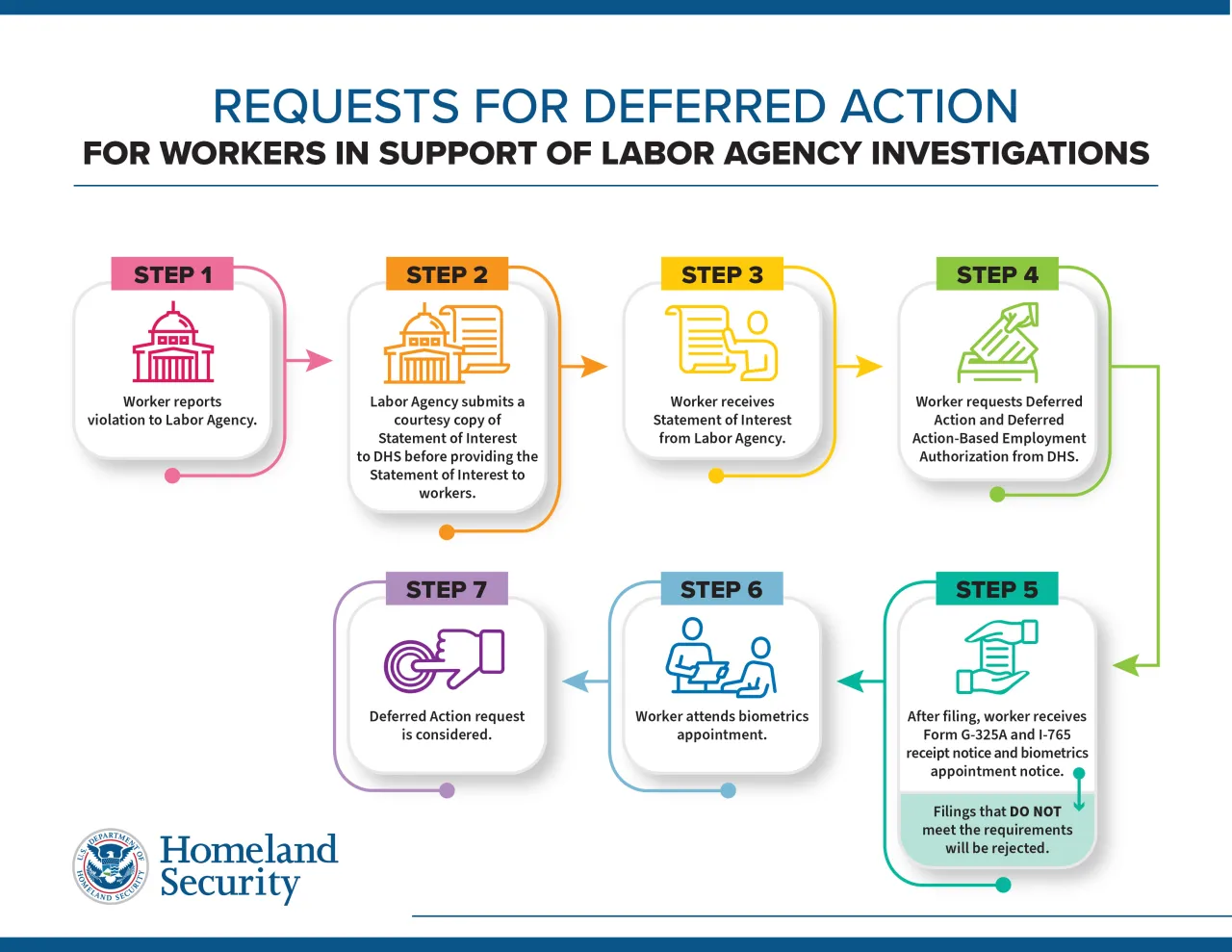
Deferred Action for Labor Enforcement (DALE) is a program designed to protect immigrant workers who report labor violations, such as wage theft or unsafe working conditions. This program provides temporary protection from deportation and a work permit, encouraging workers to speak up without fear of immigration consequences.

Application Process

Applying for DALE involves submitting a request through a specific U.S. Citizenship and Immigration Services (USCIS) process. Workers can initiate the application by requesting a Statement of Interest (SOI) from the appropriate labor agency and then filing that SOI along with Forms G-325A and I-765 to USCIS. Applicants must attend a biometrics appointment while the application process is ongoing, and will generally receive a decision within four to six months.

Image: Requests for Deferred Action for Workers in Support of Labor Agency Investigations English Infographic

Validity of Work Permits

Once approved, DALE offers a work permit that typically lasts for four years. It previously was only issued for two years, but in July of 2024, the duration of the work permit was extended to a full four years. This permit allows workers to be legally employed in the United States during this period. In some instances, the protections can be extended, especially if the worker continues to be involved in labor enforcement efforts or if the conditions warrant further protection. If you previously applied for DALE and were only given a two-year work permit card, you may be eligible to extend your work permit for an additional two years.

Support and Accessibility

DALE does not impose criminal bars, meaning that a wide range of workers, including those with past minor offenses, can apply for this protection. This broad accessibility is crucial for encouraging more workers to report labor violations without fearing retaliation in the form of deportation. However, if you do have any prior immigration or criminal violations, it is advisable to consult with an attorney about the risks associated with any application prior to filing for these benefits.


Last Updated: 7.29.2024 (*Note That Immigration Rules, Regulations, And Practices Change Frequently. Make Sure To Check For Updated Information Since The Posting Of This Article.)

President Biden’s Action to Keep Families Together (June 2024)

On June 18 2024, President Biden announced a presidential extension of the program known as “Parole in Place”. The purpose of this parole program is to allow persons that are already in the United States but who entered illegally to seek a lawful entry without having to ever leave the United States. Most popularly used by family of U.S. military members, Biden is now extending it to the spouses of U.S. citizens and their children.

Traditionally, if the spouse of a U.S. citizen entered the United States illegally, they must seek a hardship waiver and further processing of an immigrant visa for a green card (lawful permanent residency) outside of the United States, often necessitating long periods of time outside of the United States, separated from their families. Biden’s announcement is meant to keep families unified by allowing the application for a green card (lawful permanent residency) to take place within the United States, without requiring any departure from the United States or time spent abroad.

Though additional details have still yet to be announced, the known qualifications are currently that an applicant must:

  • Be present in the United States without admission or parole;
  • Have been continuously in the United States for at least 10 years as of June 17, 2024;
  • Have a legally valid marriage to a US Citizen as of June 17, 2024;
  • Not be disqualified based on criminal history;
  • Deserving of a favorable exercise of discretion.

So long as these criteria are met, the spouse and children (unmarried and under 21yo) of a US citizen may seek a “parole in place” for a period of three (3) years to allow them to obtain a work permit and to complete the immigration process more seamlessly from within the United States.

In this same announcement, President Biden remarked that he also plans to make non-immigrant visas more accessible to persons with DACA  and other Dreamers with degrees from US institutions of higher education. For these individuals who have a job offer from a U.S. employer, this new action will seek to make it possible to obtain a non-immigrant employment visa where one otherwise may not have been possible due to various immigration bars.

These programs are not yet available so please do not pay any fees associated with filings or submit documents in application for these benefits as it is not yet available. Beware of scams and persons trying to take advantage of this announcement. Additional information is expected to be released soon in order to help individuals determine whether their case may or may not benefit from this announcement. Stay tuned!


Last Updated: 6.18.2024 (*Note That Immigration Rules, Regulations, And Practices Change Frequently. Make Sure To Check For Updated Information Since The Posting Of This Article.)

President Biden’s Action to Secure the Border (June 2024)

On June 4, 2024, President Biden announced his new Presidential Proclamation to try and curb illegal border entries at the southern border. The proclamation restricts entry to the United States for those entering without a visa or other lawful permission. The new measures went into effect today, June 5, 2024. For more detailed information, please visit: https://www.whitehouse.gov/briefing-room/presidential-actions/2024/06/04/a-proclamation-on-securing-the-border/


Last Updated: 6.5.2024 (*Note That Immigration Rules, Regulations, And Practices Change Frequently. Make Sure To Check For Updated Information Since The Posting Of This Article.)

New USCIS Fees Announced for 2024!

On January 30, 2024, USCIS announced the final rule for an adjusted fee schedule. The changes to fees impact many categories of applications and will go into effect on April 1, 2024. Anything postmarked on or after April 1, 2024 will be subject to the new fees. To apply under the current fee schedule, applications must be postmarked before April 1, 2024.

USCIS press release: https://www.uscis.gov/newsroom/news-releases/uscis-issues-final-rule-to-adjust-certain-immigration-and-naturalization-fees

To read the rule in its entirety (it’s long!), you can go here: https://www.federalregister.gov/documents/2024/01/31/2024-01427/us-citizenship-and-immigration-services-fee-schedule-and-changes-to-certain-other-immigration

To read the USCIS FAQ’s about the change (much shorter), you can go here: https://www.uscis.gov/forms/filing-fees/frequently-asked-questions-on-the-uscis-fee-rule

If you need to apply for a fee waiver, you can find out your eligibility by comparing your household income to the federal poverty guidelines, which are found here: https://aspe.hhs.gov/topics/poverty-economic-mobility/poverty-guidelines

Moving? Update Your Address With Immigration!

If you have a pending application or petition with an Immigration agency, or if you are a non-US citizen, you will need to file a change of address anytime you move (unless you are in the US with a “A” or “G” visa or as a Visa Waiver Visitor). You must file the change of address with every agency that is handling your case, whether it is U.S. Citizenship and Immigration Services, the U.S. Department of State, the Immigration Court, or another agency/office.

Here are some links and information to help you get the change of address done correctly. And, remember, make sure you file your change of address the FIRST WEEK you move! Most agencies require that they be updated within 5-10 business days of your move.

If you have a case pending with U.S. Citizenship and Immigration Services (USCIS):
– Paper filing/general instructions: https://www.uscis.gov/ar-11

– Online filing: https://egov.uscis.gov/coa/displayCOAForm.do

– Special filing locations for U/T/VAWA cases: https://www.uscis.gov/addresschange

If you are a financial sponsor for an intending immigrant and have filed Form I-864:
– Paper filing: https://www.uscis.gov/i-865

If you have a case pending with the Immigration Court / Executive Office for Immigration Review (EOIR):
– Paper filing: https://www.justice.gov/eoir/form-eoir-33-eoir-immigration-court-listing

– Online filing: https://respondentaccess.eoir.justice.gov/en/forms/eoir33ic/

*Remember, anything you send to the Immigration Court, must also be sent to the Office of Principal Legal Advisor (OPLA) with Homeland Security, by mail. For the correct address, search by location: https://www.ice.gov/contact/field-off…

If you are reporting to Immigration and Customs Enforcement (ICE):
– Online filing: https://onlinechangeofaddress.ice.gov/ocoa

If you are a bond obligor:
– Paper filing: https://www.ice.gov/doclib/forms/i333.pdf

If you have a case with the National Visa Center (NVC) or the U.S. Embassy for consular processing:
– https://travel.state.gov/content/travel/en/us-visas/visa-information-resources/ask-nvc.html

HOW TO: Humanitarian Parole For Cubans, Haitians, Venezuelans, And Nicaraguans

In 2023, the Biden Administration began a process that allowed certain nationals of Cuba, Haiti, Venezuela, or Nicaragua to enter the United States through Humanitarian Parole. In an effort to curb illegal entries to the United States, and recognizing the dire need for many persons from these countries to leave difficult situations in their home countries, the humanitarian parole process allows for temporary entry and employment authorization in the United States. If you are a citizen of Cuba, Haiti, Venezuela, or Nicaragua, here is how you may seek to benefit from this program…

For starters, you must be outside of the United States and a national of Cuba, Haiti, Venezuela, or Nicaragua, and with a valid passport. If you are not a national of one of these countries, you may still qualify if you are the spouse or unmarried child under the age of 21 of a national of one of these 4 countries. For example, if you are a citizen of Mexico but you are married to a Cuban citizen and you’re living outside of the U.S., you can apply for this parole program so long as you’ll be traveling together and your Cuban citizen spouse receives parole. BUT, if your Cuban citizen spouse also has Mexican citizenship, neither of you will be eligible for this program because of your Cuban spouse’s dual nationality.

In addition to meeting the citizenship requirement, you must have a sponsor in the United States to start the process. This sponsor doesn’t have to be a U.S. citizen, but must have lawful status in the U.S. or be with parole or deferred action. If you know someone that is a U.S. citizen, a Lawful Permanent Resident, a nonimmigrant (such as with F1 student status), an Asylee or Refugee, a TPS holder, or a
DACA recipient, they may serve as your sponsor.

The sponsor must be able to document their status, be able to pass a background clearance, and have sufficient financial means to support you. Once you find someone that is willing to serve this role, they will initiate the process by creating an online U.S. Citizenship and Immigration Services (USCIS) account and filing Form I-134A. If you have a spouse or child that will be traveling with you, a separate I-134A must be filed for each person. With the I-134A form, it is necessary to include evidence about the financial ability to support you, including an explanation of the type of support to be provided. Because the sponsor is agreeing to “receive, maintain, and support” the beneficiary, the sponsor must specifically account for how this is possible. But the sponsor doesn’t have to take all the responsibility for him or herself. Meaning that multiple people can agree to help, and even organizations and businesses can agree to help. For example, if your friend, Mariam, lives in the United States with Temporary Protected Status (TPS), she can be your sponsor. But maybe she only makes $20,000 a year and doesn’t think she can pay for your housing, food, and transportation. But, Mariam knows a local community organization that is offering to help provide housing and food. And Mariam also has a friend that is offering to help you find a job and provide $250 in support per month, until you get to the U.S. and get a work permit and job. In this situation, Mariam will file and sign the I-134A form, but she will include with it an explanation from herself, the local community organization, and her friend, each explaining how they will provide for you once you arrive to the United States. Along with these letters of explanation, it is a good idea to provide other documentation that evidences the ability to provide the resources that were offered, such as photos of the available housing or a deed of title from the community organization, and tax returns or bank statements from Mariam’s friend.

Once the I-134A is filed and submitted online, USCIS will review it, check for the criminal clearance of the sponsor, and make a determination about whether to authorize the sponsorship. This part of the process may take several months or more. Then, assuming the sponsor is confirmed, you will receive an email from USCIS with instructions about how to create your own online USCIS account. You’ll create this account and confirm the information about yourself and your qualifications. In doing so, you will confirm that you have all required vaccinations to enter the U.S., including vaccinations for Measles,Polio, and COVID-19.

After you confirm the information with USCIS, you will receive instructions in your new online account about how to access the CBP One app on your phone. You will enter your personal information into the application and provide a photo of yourself. Once all information is entered into the CBP One app, you will wait to receive notice about whether Customs and Border Protection (CBP) has decided to authorize you to travel the United States to request parole at a port of entry. Assuming CBP has decided to grant you this opportunity, you’ll receive travel authorization that is valid for 90 days. You must enter the United States during those 90 days, traveling by air to an internal port of entry. It is at that port of entry that you will request parole.

Once you arrive by plane to a receiving airport in the United States, you will meet with a CBP officer who will run your fingerprints for a background check and you will provide an explanation and documentation for the reasons why you are seeking parole into the U.S. It is advisable to have your explanation and documentation well-prepared and easy to understand so that you can simply and quickly present it to the officer when you are at the airport. For example, maybe the circumstances in your home country caused you to lose your job or your housing, maybe it is no longer safe there for your children to attend school, or maybe you are no longer able to freely express your political or religious beliefs in your home country. Be prepared to clearly express your personal reasons for leaving your home country and seeking temporary entry into the U.S.

If the officer agrees to parole you into the United States, you will typically be allowed entry for a two (2) year period and you will be eligible to apply for a work permit. It is a good idea to apply for that work permit as soon as possible, by filing Form I-765. Remember also that you are required to update your contact information (phone number, email, and physical address) with USCIS if it changes after you enter the United States. You can do this through your online USCIS account that you created during the application process.

Who Is Not Eligible For This Process?
  • If you fail the security clearance
  • If you are unable to demonstrate that the U.S. government should exercise its discretion in your
    favor
  • If you have been ordered removed from the U.S. in the last 5 years
  • If you are subject to a bar based on a prior removal order
  • If you entered the U.S. illegally and not at a port of entry after October 19, 2022 for Venezuelans
    and after January 9, 2023 for Cubans, Haitians, and Nicaraguans
  • If you are Cuban or Haitian and were intercepted at sea trying to come to the U.S. after April 27,
    2023; or
  • If you are under 18 years of age and not traveling with a parent or legal guardian
Sources:
Last Updated: 10.15.2023 (*Note That Immigration Rules, Regulations, And Practices Change Frequently. Make Sure To Check For Updated Information Since The Posting Of This Article.)